

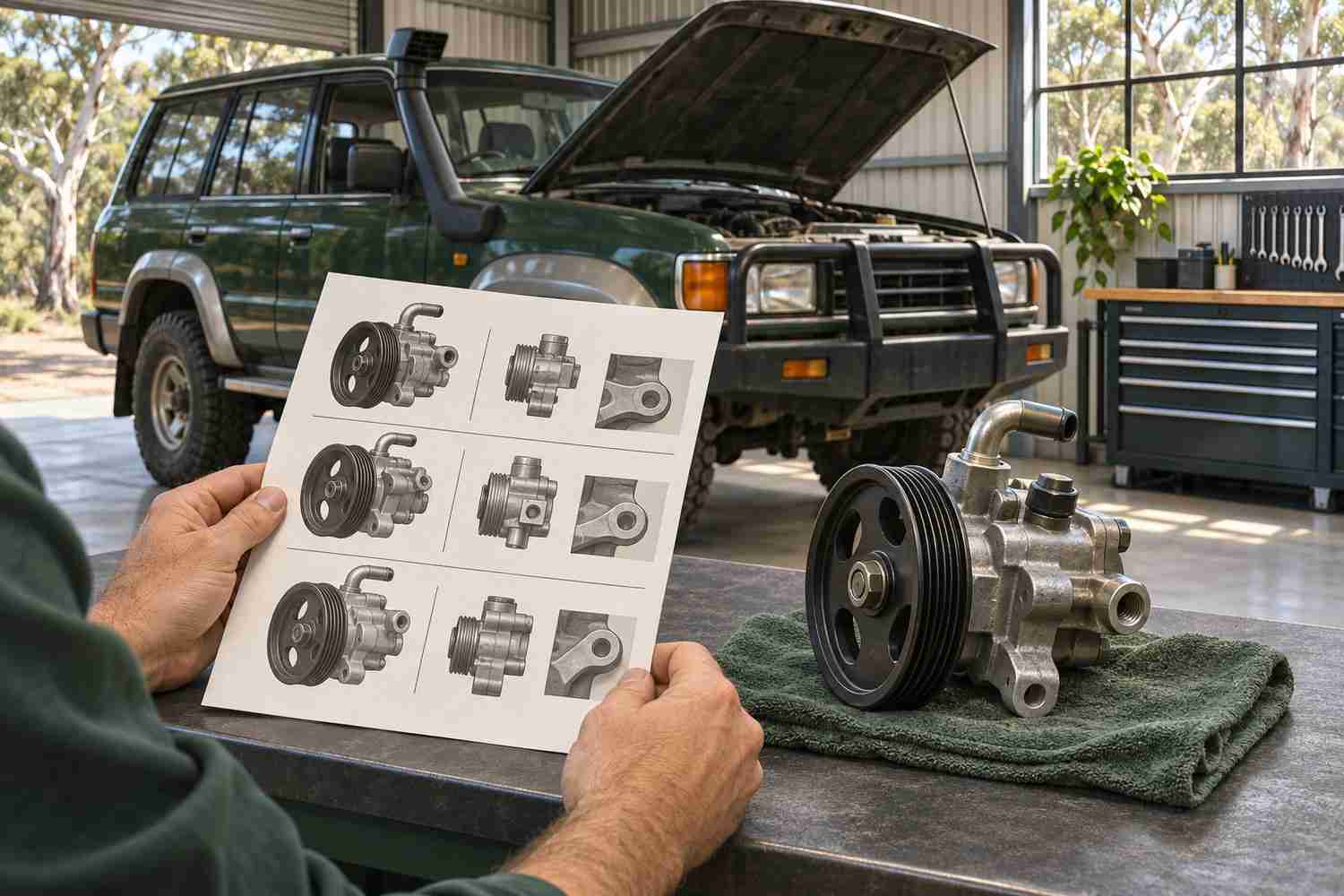
A Hilux, Prado or LandCruiser badge is a starting point, not a steering-pump specification. Within these ranges, the replacement can change with the engine, the way the pump is driven and the equipment fitted to that particular build. A pump that looks convincing in a small photograph can still have the wrong drive, hose arrangement or electrical connection.
The useful question before ordering is: which configuration is actually on this vehicle? This guide compares selected Australian applications in our catalogue. It is an identification aid, not a claim that every vehicle within a year range takes the same pump.
Start with the engine code, then the original reference
Write down the chassis or series code, engine code and build month from the vehicle documentation. Keep the VIN available for a catalogue check. Registration year alone can obscure a production change, and engine capacity alone leaves important differences unresolved.
For example, the KZN165 Hilux application below uses the 1KZ-TE engine and a gear-driven pump. The later GUN126 1GD-FTV example uses a pulley-driven assembly. These are separate applications; the fact that both vehicles are diesel Hiluxes does not establish interchangeability.
Photograph every readable number on the original pump. A casting mark may identify a component of the housing rather than the complete assembly, so have it checked against the vehicle catalogue instead of assuming that any matching group of digits is sufficient.
Gear drive and pulley drive are a fundamental difference
A pulley-driven pump has an external belt pulley. A gear-driven assembly presents a drive gear and mounting flange instead. This is a useful first screening step because the wrong drive type cannot be resolved by choosing a similar-looking hose fitting.
The selected Prado 150 3.0L 1KD-FTV pump is gear driven. The selected Prado 150 2.8L 1GD-FTV unit has a multi-rib pulley and solenoid. The LandCruiser 70 VDJ example is gear driven, while the UZJ100 4.7L petrol example includes a pulley. These are observations about the linked assemblies, not a rule covering every Toyota engine.
Selected applications and the details to verify
Use each link to inspect that product’s complete build scope, inclusions and actual photographs. The references in different rows are not interchangeable. Where a row lists more than one confirmed reference, the individual product page explains its supported application.
Two build and equipment traps deserve extra attention
Hilux GUN126 around the 2020 change: the linked 44310-0K130 assembly is the earlier configuration without an electrical solenoid connection. April–June 2020 builds need a VIN and original-pump check because a later solenoid arrangement is a separate selection. Do not use a broad “2015 onwards” description to bypass that check.
HDJ100 with EGR-cooler equipment: the linked 44310-60420 pump is conditional on the original reference and gear configuration matching the EGR-cooled application. A 4.2L engine and a suitable year are not enough. Match the mounting flange, hydraulic connections and gear-tooth direction; do not infer a tooth count from an unclear photograph.
What to include in a useful fitment enquiry
- The VIN, chassis code, engine code and build month.
- A readable original reference or clear photographs of all markings.
- A front view showing the pulley or drive gear.
- A side view showing the hydraulic connections and any electrical fitting.
- A mounting-face view, if the pump is already safely removed.
- Details of any engine conversion or previous steering-system modification.
Keep protective shipping caps separate from electrical connectors when comparing photographs. An actual solenoid or connection should match the original arrangement; a similar colour or shape alone does not establish the terminal count or function. Do not modify the vehicle loom or hose arrangement to make an unconfirmed pump fit.
Identification comes before replacement
A parts match does not diagnose a heavy-steering or noise complaint. Leaks, air ingress and other faults need assessment in the context of the complete system. For the existing broader Hilux discussion, see our Hilux power-steering problems guide. This article’s job is to help identify the replacement configuration after that assessment.
Before installation, the workshop should confirm the vehicle-specific fluid, sealing parts and service procedure. This comparison does not supply a universal pressure specification, torque setting or bleeding sequence. If a replacement requires changing the original pulley, confirm the correct transfer procedure and whether the original pulley is reusable.
Open the relevant product page above for current availability and the exact assembly supplied. Send the original-pump photographs with the vehicle details if any feature remains uncertain. A reference check before ordering is more useful than discovering a different gear or connector when the vehicle is already apart.
Featured image: original AI-generated editorial illustration, not a photograph of a particular replacement part. Use the linked product photographs for exact identification. Application details checked against the current Parts Factory Australia catalogue on 3 November 2026.